
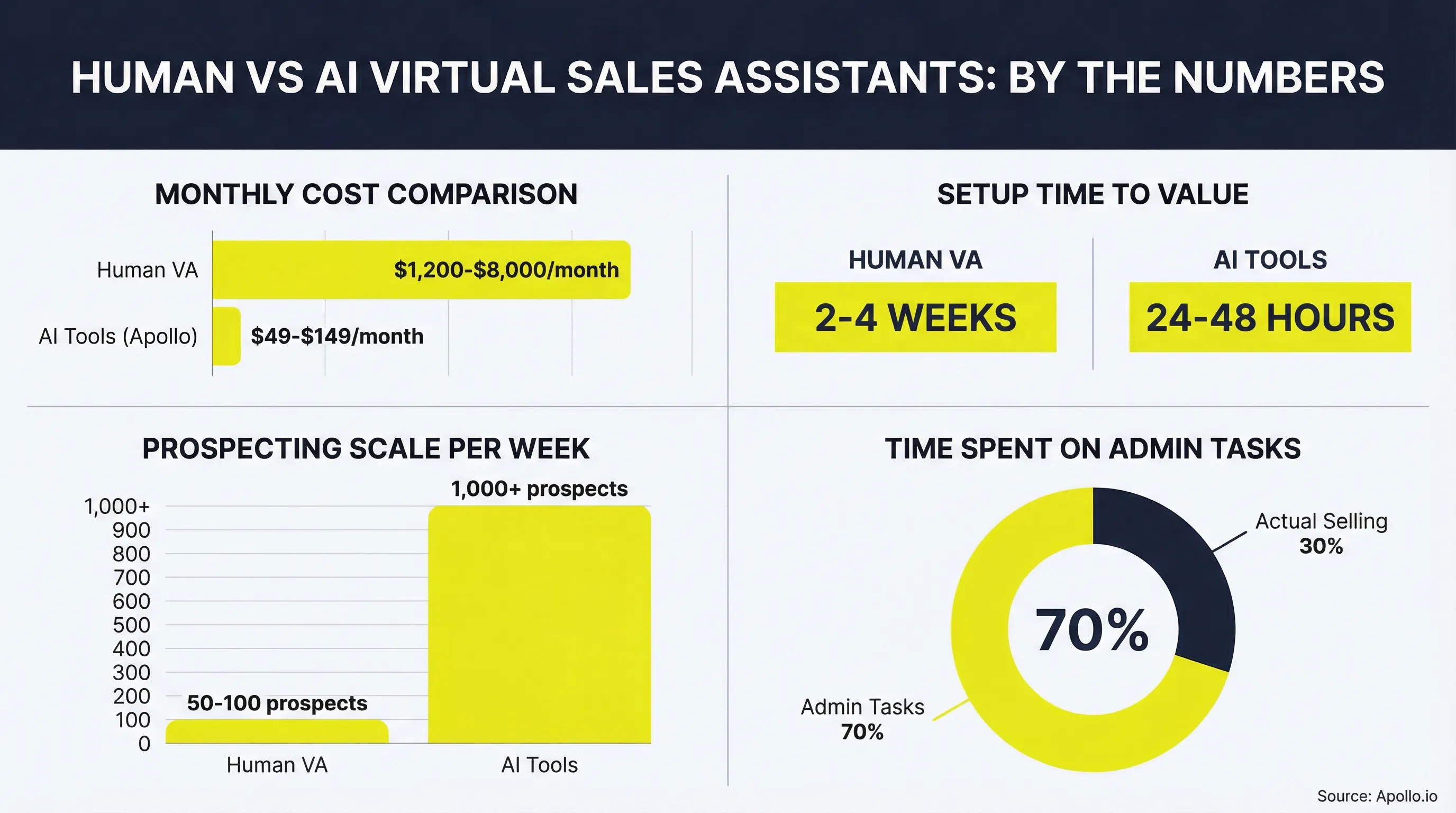
Sales reps spend at least 70% of their time on administrative tasks rather than actually selling. If you're researching virtual sales assistant options, you're likely facing this exact challenge: too much time on data entry, prospecting, and follow-ups, not enough time closing deals. This guide examines both human virtual assistants and AI-powered sales tools to help you choose the right solution for your team's needs and budget.
Key Takeaways
- Human virtual assistants excel at relationship nurturing, complex follow-ups, and personalized outreach requiring emotional intelligence
- AI-powered sales tools dominate at data enrichment, lead research, and prospecting automation at scale
- Cost comparison: Human VAs typically range from $1,200-$8,000 monthly; AI platforms start around $49-$149 monthly for unlimited usage
- Best results come from hybrid strategies combining AI for prospecting efficiency with human touch for relationship management
- ROI timeline differs significantly: Human VAs require 2-4 weeks onboarding; AI tools deliver value within 24-48 hours
What Is a Virtual Sales Assistant?
The term encompasses two distinct categories of sales support, each serving different needs. Understanding this distinction is critical for making the right investment decision.
Human virtual sales assistants are remote professionals who handle sales support tasks from any location. They work on hourly or contract basis, managing activities like CRM updates, appointment scheduling, cold calling, and lead qualification through direct conversation.
AI virtual sales assistants are software platforms that automate sales workflows through technology. These systems handle prospecting, data enrichment, email sequences, and pipeline management without human intervention.
The global AI assistant market reached $16.29 billion in 2024 and is projected to grow to $73.80 billion by 2033, reflecting massive enterprise adoption. Meanwhile, demand for human virtual assistants has increased 35% over the past year, driven by remote work expansion and need for flexible support.
Both solutions address the same core problem—sales teams drowning in administrative work—but they solve it through fundamentally different approaches. Your choice depends on your sales motion, deal complexity, and volume requirements.
Human Virtual Sales Assistants: Capabilities and Best Use Cases
Remote sales professionals bring conversational intelligence and strategic judgment that technology can't yet replicate. Here's what they handle effectively:
Core Capabilities
- CRM data entry and maintenance: Manual record updates, contact information verification, opportunity tracking
- Calendar management: Scheduling appointments across time zones, coordinating complex multi-stakeholder meetings
- Cold calling and warm outreach: Phone-based prospecting, lead qualification through conversation
- Personalized follow-up sequences: Customized emails that adapt to prospect responses and context
- Sales pipeline management: Tracking deal stages, identifying stalled opportunities, prompting next actions
- Prospect research: Gathering company intelligence, identifying decision-makers, understanding organizational structure
- Sales documentation: Preparing proposals, formatting presentations, creating quote documents
- Reporting: Compiling performance metrics, tracking KPIs, monitoring team activity
When Human VAs Excel
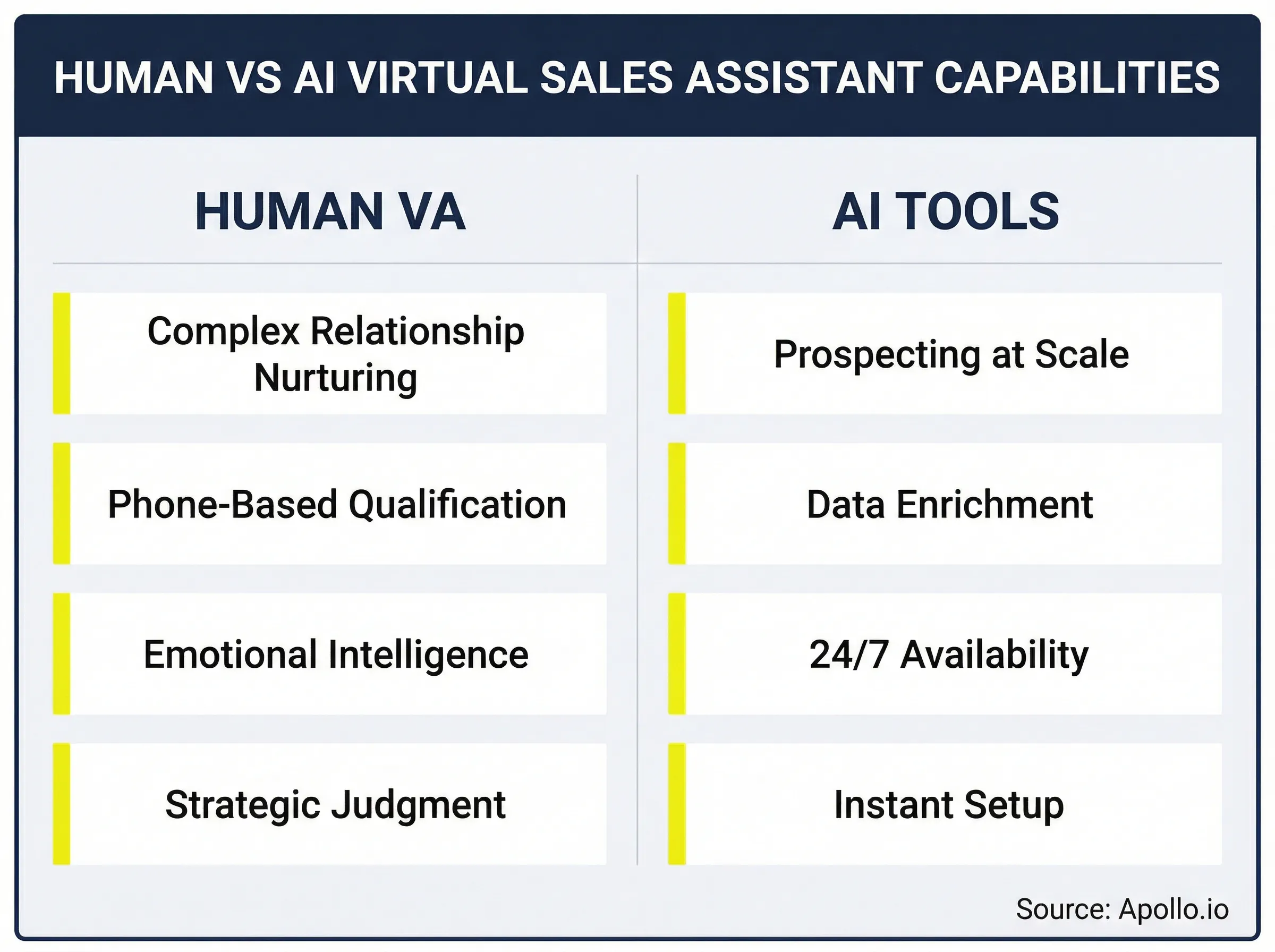
Remote professionals deliver superior results in scenarios requiring nuanced judgment. They're particularly valuable for complex relationship nurturing where emotional intelligence matters—reading between the lines in prospect conversations, adapting messaging based on subtle cues, and handling objections with empathy.
High-touch enterprise sales cycles benefit most from human support. When deals involve 10+ touchpoints across multiple stakeholders, a skilled assistant can manage the coordination complexity while maintaining personalized communication at each stage.
Phone-based selling remains a human domain. While AI can dial numbers, it can't yet handle the conversational dynamics of discovery calls, objection handling, or relationship building that happens in real-time dialogue.
Cost Structure
According to industry salary data, the average annual salary for virtual assistants is $45,000, with high-end specialists earning up to $70,000 annually. Certified VAs earn approximately 15% more than non-certified professionals.
When hiring on contract or hourly basis, rates typically range from $15-$50 per hour depending on region, expertise, and specialization. Monthly commitments usually span 20-160 hours, translating to $300-$8,000 in direct costs.
Hidden costs include training time (2-4 weeks before full productivity), management overhead (weekly check-ins, task delegation, quality review), and backup coverage when your assistant is unavailable. The total investment extends beyond the hourly rate.
ROI timeline requires patience. Most remote assistants need 2-4 weeks to learn your processes, tools, and sales methodology before delivering consistent value.
AI-Powered Sales Tools: The Automation Advantage
Technology-driven platforms handle repetitive, data-intensive tasks with speed and scale that human assistants can't match. Here's where automation delivers maximum impact:
What AI Sales Tools Automate
- Contact and company data enrichment: Automatically appending verified emails, phone numbers, job titles, and firmographic data
- Lead scoring and prioritization: Analyzing engagement signals to identify high-intent prospects
- Prospecting at scale: Building targeted lists of hundreds or thousands of prospects matching your ideal customer profile
- Email sequence automation: Multi-touch campaigns with A/B testing and performance tracking
- Meeting scheduling: Intelligent calendar coordination eliminating back-and-forth emails
- CRM auto-logging: Capturing every interaction, email, and call automatically without manual entry
- Sales analytics: Real-time dashboards showing pipeline health, conversion rates, and activity metrics
- Competitive intelligence: Monitoring prospect technology stacks, funding events, and buying signals
When AI Tools Excel
Automation dominates in high-volume prospecting scenarios. When you need to build lists of hundreds or thousands of potential customers, AI platforms complete in hours what would take human assistants weeks.
Data accuracy and enrichment across large databases is where technology shines. Real-time verification ensures contact information stays current, while automated enrichment fills gaps in your CRM without manual research.
Repetitive task automation—email sequences, data entry, activity logging—eliminates the tedious work that consumes sales rep time. Research shows AI could potentially double selling time by handling non-value-added work, with the technology delivering over 30% increase in win rates across the sales funnel.
Scalability is perhaps the biggest advantage. The same monthly subscription supports one rep or one hundred, with no proportional cost increase as your team grows.
Apollo as a Leading Example
Our platform demonstrates how AI-powered sales assistance works in practice. With access to 275M+ contacts and 73M+ companies, Apollo enables prospecting at scale that would be impossible manually.
Key features include engagement sequences that automate multi-touch campaigns, built-in email verification ensuring data accuracy, and a Chrome extension for prospecting anywhere on the web. The integrated dialer and email tracking provide complete visibility into prospect interactions.
The pricing advantage is substantial: starting at $49/month versus $2,400+ monthly for part-time human assistance. For teams needing to prospect hundreds of accounts simultaneously, the ROI is immediate.
Cost Structure
Subscription models typically range from $49-$149 monthly for most sales teams, with unlimited usage within plan limits. There are no hourly constraints or overtime costs.
Implementation delivers immediate ROI. No training period required—teams can start prospecting within 24-48 hours of signup. Sales organizations report 40-60% time savings on prospecting activities after implementing automation platforms.

Get 1,000+ Prospects Weekly for Less Than One VA Hour
Trusted by over 500,000 companies who've replaced expensive, slow manual prospecting with AI automation. Build targeted lists, enrich data, and launch sequences in 24-48 hours—not weeks.
Learn More →Head-to-Head Comparison
Understanding how these solutions stack up across critical factors helps clarify which fits your specific needs:
| Feature/Capability | Human Virtual Assistant | AI Tools (Apollo) | Winner |
|---|---|---|---|
| Initial Cost | $1,200-$8,000/month | $49-$149/month | AI |
| Setup Time | 2-4 weeks | 24-48 hours | AI |
| Prospecting Scale | 50-100 prospects/week | 1,000+ prospects/week | AI |
| Data Accuracy | Manual verification, prone to errors | Real-time verification, 95%+ accuracy | AI |
| Personalization Quality | High - contextual understanding | Medium - template-based with variables | Human |
| Complex Relationship Nurturing | Excellent - emotional intelligence | Limited - rule-based only | Human |
| Phone-Based Qualification | Strong - conversational ability | Not applicable | Human |
| CRM Data Entry | Manual, time-consuming | Automatic, instant | AI |
| Availability | Business hours, vacation/sick time | 24/7/365 | AI |
| Scalability | Linear (more hours = more cost) | Exponential (same cost, unlimited scale) | AI |
| Strategic Judgment | Can adapt to nuanced situations | Follows programmed rules only | Human |
The pattern is clear: AI tools win on cost, speed, scale, data accuracy, and automation. Human VAs win on personalization depth, relationship complexity, and strategic judgment.
This isn't about declaring an absolute winner—it's about matching the solution to your sales motion. Transactional sales with high prospect volumes favor automation. Enterprise sales with complex stakeholder dynamics favor human intelligence.
The Hybrid Approach: Combining Human and AI
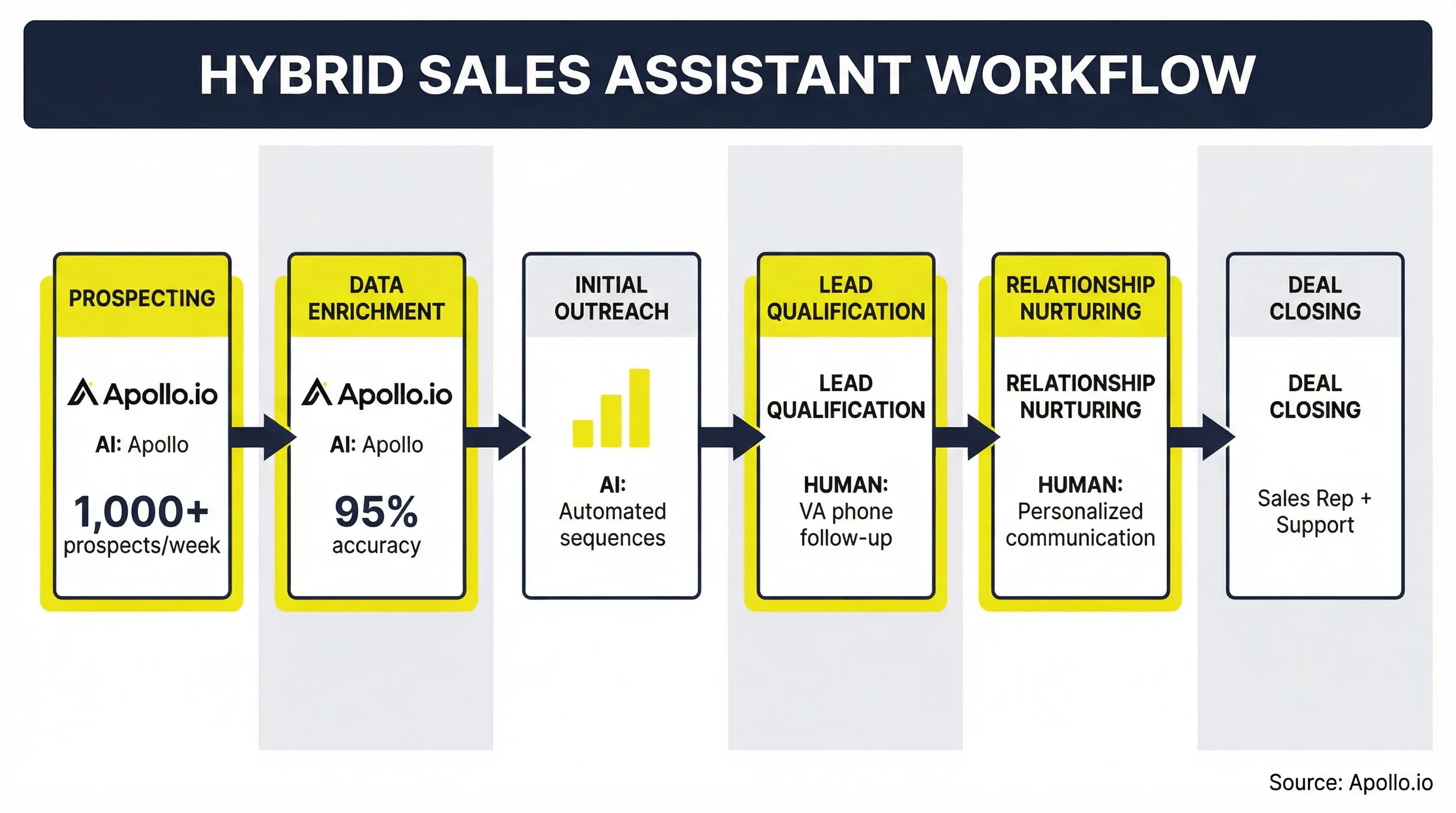
The most sophisticated sales teams don't choose between these options—they strategically deploy both. AI handles the "hunting" (prospecting, data enrichment, initial outreach) while humans handle the "farming" (relationship nurturing, complex deals, strategic account management).
The Hybrid Workflow in Action
Here's how leading sales organizations structure the collaboration:
- Prospecting (Apollo): Build targeted lists of 1,000+ prospects matching your ideal customer profile using filters for industry, company size, technology stack, and decision-maker titles
- Data Enrichment (Apollo): Automatically enrich contacts with verified emails, direct dials, and company intelligence
- Initial Outreach (Apollo): Launch automated email sequences with A/B testing to identify engaged prospects
- Lead Qualification (Human VA): Assistant follows up with engaged prospects via phone to qualify interest and understand needs
- Relationship Nurturing (Human VA): Assistant manages ongoing communication, sends personalized follow-ups, coordinates complex scheduling
- Deal Progression (Sales Rep + Apollo): Rep focuses on demos and closing while Apollo tracks engagement and VA handles administrative coordination
Resource Allocation Strategy
Allocate approximately 70% of your prospecting budget to AI tools for maximum coverage. This ensures you're reaching enough prospects to keep your pipeline full.
Reserve 30% for human assistance on high-value accounts where relationship complexity justifies the investment. This might mean dedicating a VA to your top 20 enterprise opportunities while automation handles the remaining 200 mid-market prospects.
Expected ROI from this combined approach: 3-5x improvement in pipeline generation versus human-only strategies, with better conversion rates than automation-only approaches.
How to Choose the Right Solution
Your decision should align with your specific sales motion, deal economics, and growth stage. Here's the framework:
Choose Human Virtual Assistants If:
- Your average deal size exceeds $50K, justifying high-touch investment
- Sales cycles involve 10+ touchpoints with multiple stakeholders requiring coordination
- Your industry demands deep relationship building (financial services, consulting, professional services)
- You have fewer than 100 target accounts in a named account strategy
- Phone-based selling is your primary channel and conversational qualification is critical
- You need executive calendar management and complex scheduling coordination
Choose AI Tools Like Apollo If:
- You need to prospect hundreds or thousands of companies simultaneously
- Data accuracy and contact information are constant challenges slowing your team
- Your sales team spends 10+ hours weekly on manual research and list building
- You run email-based outbound campaigns at scale
- Your CRM data is incomplete or outdated, hurting pipeline visibility
- Budget constraints limit human hiring ($49/month vs. $2,400/month represents significant savings)
- You need immediate results without 2-4 week onboarding periods
Choose the Hybrid Approach If:
- You have both volume prospecting needs AND high-value accounts requiring white-glove treatment
- Your sales team is growing and needs scalable infrastructure that can expand without linear cost increases
- You want to maximize ROI across the entire sales funnel from initial contact through close
- You're committed to sales excellence at every stage of the buyer journey
Getting Started: Implementation Roadmap
The path to implementation differs significantly between these options. Here's what to expect:
For AI Implementation (Apollo)
- Week 1: Sign up for Apollo, integrate with your CRM, import existing contacts for enrichment
- Week 2: Build your first prospect lists using advanced filters, launch initial email sequences with proven templates
- Week 3: Analyze engagement data, refine messaging based on open and reply rates, scale successful campaigns
- Week 4: Train team on advanced features including the dialer, Chrome extension, and analytics dashboards
For Human VA Implementation
- Week 1-2: Define role requirements, document processes, interview candidates from established services
- Week 3-4: Onboard selected assistant, provide access to systems, establish communication protocols
- Week 5-6: Training period with supervised tasks, feedback loops, and process refinement
- Week 7-8: Full delegation with regular check-ins and performance reviews
For Hybrid Implementation
Start with Apollo for immediate prospecting wins in weeks 1-2. This generates pipeline quickly while you're recruiting human support.
Add human assistance once pipeline volume justifies relationship management support, typically weeks 4-6. By this point, you'll have qualified opportunities that benefit from personalized nurturing.
Establish clear handoff protocols between AI and human touchpoints. Define exactly when prospects transition from automated sequences to human follow-up based on engagement signals.
Making Your Decision
The virtual sales assistant landscape offers powerful options for every sales team, from solo entrepreneurs to enterprise organizations. AI tools like Apollo deliver unmatched efficiency for prospecting and data management, while human VAs provide irreplaceable relationship intelligence for complex sales.
The winning strategy for most teams combines both: AI for scale and efficiency, humans for depth and relationship complexity. Start with your biggest pain point—if it's prospecting volume and data quality, begin with Apollo; if it's relationship management and coordination, start with a human assistant.
Ready to transform your sales prospecting with AI-powered automation? Try Apollo free for 14 days and see how intelligent sales assistance can multiply your pipeline without multiplying your costs.
Join 550K+ Companies Scaling Smarter with Apollo
Whether you choose AI-only or hybrid approach, Apollo eliminates the prospecting bottleneck holding your team back. All-in-one sales intelligence and engagement platform with free plan available—no credit card required. Start building pipeline today, not weeks from now.
Get Started Free →