
Modern B2B sales teams face unprecedented complexity. Buyers conduct extensive research before engaging with sellers, buying committees span multiple departments, and sales cycles stretch longer than ever. In this environment, equipping your revenue team with the right resources at the right moment isn't optional—it's essential for competitive survival.
Key Takeaways
- Sales enablement platforms unify content management, training, coaching, and analytics to systematically improve seller effectiveness and accelerate revenue growth.
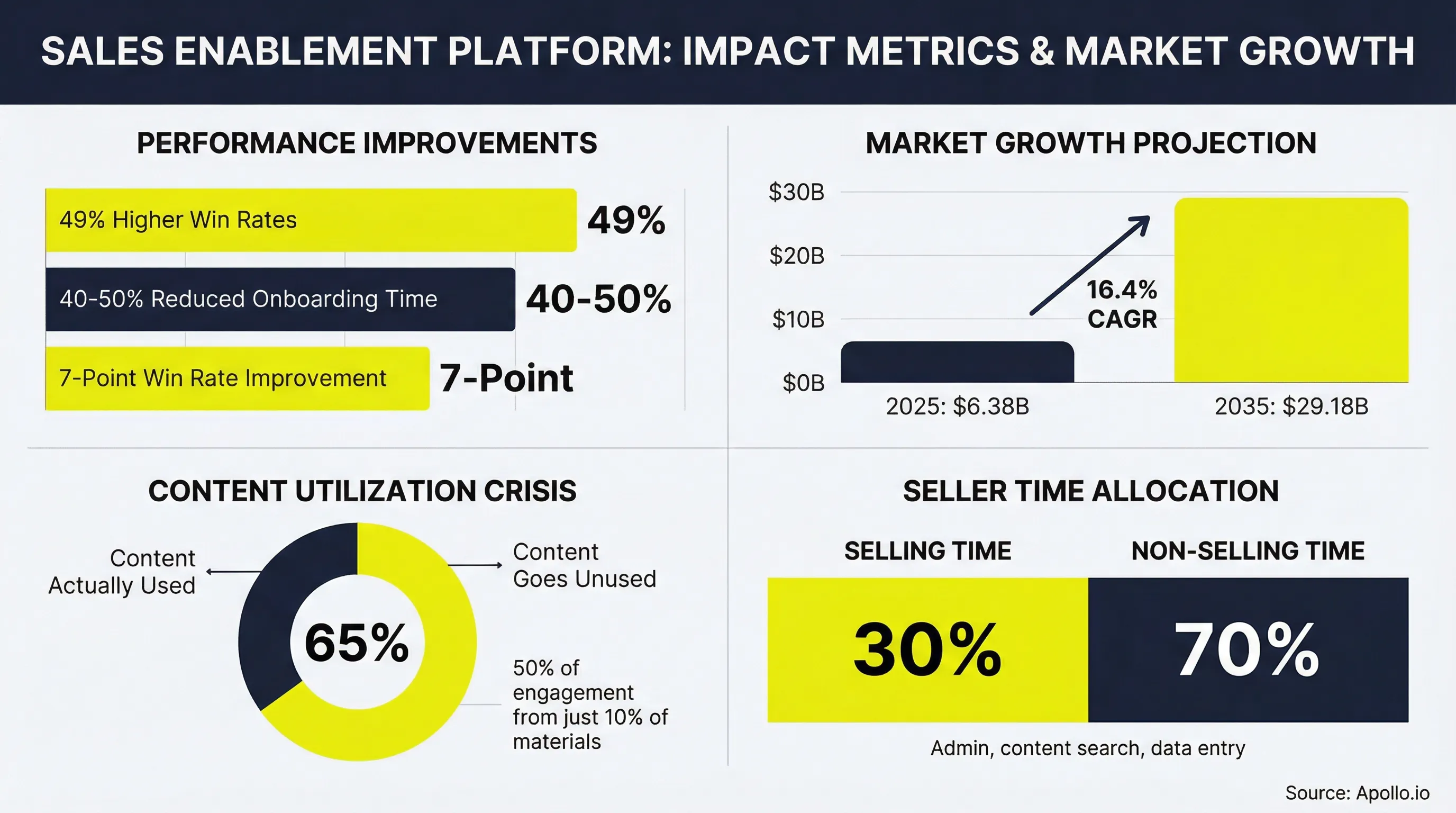
- Organizations with formal enablement programs achieve 49% higher win rates on forecasted deals and reduce onboarding time by 40-50%.
- Essential platform features include AI-powered content intelligence, CRM integration with sales intelligence data, conversation analytics, and automated coaching workflows.
- The global market is projected to grow from $6.38 billion in 2025 to $29.18 billion by 2035, driven by AI integration and revenue operations convergence.
- Successful implementation requires clear pain point assessment, defined success metrics, stakeholder buy-in, and phased rollout strategies.
What Is a Sales Enablement Platform?
A sales enablement platform is a unified technology solution that equips revenue teams with content, training, coaching, and analytics needed to consistently engage buyers and close deals effectively. Unlike standalone tools that address isolated needs, these platforms integrate multiple capabilities into a cohesive system that supports sellers throughout the entire customer lifecycle.
The technology differs fundamentally from CRM systems, which track customer relationships and pipeline data. While CRMs answer "who are our customers and where are deals?" enablement platforms answer "how do we prepare our team to win those deals?" They also extend beyond learning management systems (LMS), which focus primarily on training delivery, by connecting learning directly to content usage, buyer engagement, and revenue outcomes.
According to Future Market Insights, the market reached $6.38 billion in 2025 and is projected to grow to $29.18 billion by 2035, reflecting a 16.4% compound annual growth rate. This expansion is driven by the convergence of revenue operations, generative AI integration, and the shift from static content repositories to data-driven buyer engagement engines.
Why Revenue Teams Need Enablement Platforms
The modern selling environment creates challenges that traditional approaches can't solve. Sales professionals spend only 30% of their time actually selling during an average week, according to industry research. The remaining 70% disappears into administrative tasks, content searches, and manual data entry—activities that don't directly generate revenue.
Content sprawl compounds this productivity drain. Industry research reveals that 65% of company content goes completely unused by sales teams, while 50% of all prospect engagement comes from just 10% of materials in content libraries. Without a centralized system to organize, surface, and track the right assets, sellers waste valuable time hunting for resources or presenting outdated information to prospects.
Remote and hybrid work models add another layer of complexity. Distributed teams need consistent training, coaching, and messaging regardless of location. Traditional in-person enablement approaches don't scale across geographies or time zones, creating inconsistent buyer experiences and performance gaps between high and low performers.
Organizations maintaining formal enablement processes for more than two years report a 7-percentage-point improvement in win rates, demonstrating that systematic approaches deliver measurable competitive advantages over time.
Core Platform Capabilities
Effective solutions combine several integrated capabilities that work together to support revenue team performance.
Content Management and Intelligence
Centralized repositories store all customer-facing materials—presentations, case studies, product sheets, proposals, and competitive intelligence—in a single searchable location. AI-powered search functions help sellers quickly find relevant assets based on industry, buyer persona, deal stage, or specific use cases.
Content analytics track which materials drive engagement and conversions. These insights reveal which assets prospects view longest, which sections generate questions, and which resources correlate with closed deals. Marketing teams use this data to prioritize content creation efforts on high-impact materials rather than producing assets that never get used.
Version control and governance features ensure sellers always access current, approved materials. When product messaging changes or compliance requirements update, administrators can instantly retire outdated content and push new versions to the entire team.
Training and Onboarding Tools
Structured learning paths guide new hires through product knowledge, sales methodologies, competitive positioning, and company processes. Microlearning modules deliver bite-sized lessons that fit into busy schedules, while retention quizzing reinforces key concepts and identifies knowledge gaps.
Certification tracking ensures sellers demonstrate competency before engaging with prospects. Managers can require completion of specific training modules before reps gain access to certain content or accounts, maintaining quality standards across the organization.
Organizations using these platforms cut onboarding time by 40-50%, according to industry research, helping new representatives start contributing to revenue faster.
Coaching and Practice Capabilities
AI-powered pitch practice allows sellers to record presentations and receive automated feedback on delivery, messaging adherence, and talk-track effectiveness. This technology analyzes factors like pace, filler words, confidence indicators, and key message inclusion.
Call recording and conversation intelligence capture actual customer interactions, providing coaching opportunities based on real-world performance rather than hypothetical scenarios. Managers can identify patterns across successful deals—such as specific questions that uncover pain points or objection-handling techniques that advance opportunities.
Coaching workflows streamline manager-seller interactions by surfacing specific calls or pitches that need attention, providing structured feedback templates, and tracking coaching activity completion. This systematic approach ensures consistent development across the entire team rather than ad-hoc guidance for a few individuals.
CRM Integration and Sales Intelligence
Seamless connectivity with customer relationship management systems is non-negotiable for modern platforms. This integration enables real-time data synchronization, automatically logging content usage, training completion, and buyer engagement directly into opportunity records.
The most effective implementations connect enablement platforms to comprehensive sales intelligence layers that provide accurate firmographic data, buying signals, and contact information. Apollo serves as this intelligence foundation, enriching enablement systems with verified prospect data, intent signals, and account insights that make content recommendations contextually relevant.
When a seller opens an opportunity record, the platform can automatically suggest materials based on the prospect's industry, company size, technology stack, and current buying stage—all powered by the underlying intelligence data. This eliminates guesswork and ensures every interaction is informed by accurate, current information about the buyer's situation.
Without this data foundation, even sophisticated enablement platforms operate partially blind, unable to deliver truly personalized recommendations or measure content effectiveness against specific account characteristics.
Analytics and Reporting
Comprehensive dashboards provide visibility into content effectiveness, training completion rates, skill development progress, and revenue impact attribution. Leaders can identify which enablement activities correlate with improved win rates, shorter sales cycles, or larger deal sizes.
Rep readiness scorecards aggregate multiple signals—training completion, certification status, content usage patterns, and performance metrics—to give managers a holistic view of each seller's preparedness. This helps prioritize coaching resources on team members who need the most support.
Predictive analytics identify at-risk deals based on engagement patterns, allowing managers to intervene before opportunities stall. If a prospect hasn't engaged with shared content or a seller hasn't followed recommended next steps, the system can trigger alerts and suggest corrective actions.
Advanced Differentiating Features
Leading platforms extend beyond core capabilities with sophisticated features that create competitive advantages.
AI-Powered Content Personalization
Artificial intelligence analyzes buyer signals—website visits, content downloads, email engagement, and conversation topics—to recommend the most relevant materials for each interaction. Rather than manually searching through hundreds of assets, sellers receive curated suggestions tailored to the specific prospect's interests and stage in the buying journey.
This personalization depends heavily on the quality of underlying buyer intelligence data. When platforms integrate with Apollo's buying intent data, they gain access to intent signals, technographic data, and firmographic insights that make recommendations genuinely relevant rather than generic. A seller engaging with a mid-market healthcare company evaluating specific technologies receives completely different content suggestions than someone speaking with an enterprise financial services prospect.
Generative AI capabilities now enable automatic customization of presentations and proposals based on prospect-specific information, reducing manual personalization time while maintaining relevance. The technology can adapt messaging, swap out case studies for similar companies, and adjust positioning based on detected pain points—all without requiring sellers to rebuild decks from scratch.
Conversation Intelligence
Real-time call guidance provides in-the-moment support during customer conversations. As prospects mention specific topics, competitors, or objections, the system can surface relevant talking points, competitive battle cards, or objection-handling scripts directly on the seller's screen.
Sentiment analysis tracks emotional tone throughout conversations, helping sellers recognize when prospects become confused, frustrated, or excited. This awareness allows representatives to adjust their approach dynamically rather than following a rigid script regardless of buyer reactions.
Competitive mention tracking automatically flags when prospects bring up alternative solutions, triggering alerts to sales leaders and capturing valuable market intelligence about which competitors appear most frequently in deals.
Mobile Enablement
Field sales representatives need access to content, training, and insights regardless of location or connectivity. Mobile-optimized platforms provide full functionality on smartphones and tablets, including offline access to critical materials when internet connections aren't available.
This capability is particularly valuable for industries like medical devices, manufacturing, and financial services where sellers frequently meet prospects at their locations rather than in traditional office settings.
Revenue Intelligence Integration
Advanced platforms connect enablement activities directly to pipeline influence and deal velocity metrics. This integration reveals which specific training modules, content assets, or coaching interventions correlate with faster progression through sales stages or higher close rates.
Deal velocity impact measurement shows how enablement investments affect the time required to move opportunities from stage to stage, helping leaders quantify the financial return of their programs.

Turn Content Recommendations From Generic to Contextual
Without accurate prospect intelligence, even AI-powered platforms can't deliver relevant suggestions. Apollo's all-in-one sales intelligence and engagement platform provides the technographic insights, buying signals, and firmographic data your enablement stack needs to truly personalize every interaction.
Learn More →Platform Selection Framework
Choosing the right solution requires systematic evaluation aligned with your organization's specific needs and goals.
Step 1: Assess Current State and Pain Points
Begin by identifying your most pressing challenges. Are sellers struggling to find relevant content? Do new hires take too long to become productive? Is coaching inconsistent across managers? Do you lack visibility into what's working?
Different pain points require different platform strengths. Organizations with severe content chaos need robust management and search capabilities. Teams with training gaps should prioritize learning and certification features. Companies struggling with coaching scalability benefit most from conversation intelligence and automated feedback tools.
Consider team size and geographic distribution as well. A 20-person sales team in one location has fundamentally different needs than a 500-person global organization spanning multiple regions, languages, and time zones.
Sales complexity and cycle length also matter. Transactional sales with short cycles may need less sophisticated capabilities than enterprise deals involving multiple stakeholders, technical evaluations, and six-month decision processes.
Step 2: Define Success Metrics
Establish clear, measurable goals before evaluating vendors. What specific improvements would justify the investment?
Common success metrics include:
- Ramp time reduction: Decrease time for new hires to reach full productivity by 30-50%
- Content utilization: Increase percentage of marketing materials actually used by sellers from 35% to 60%
- Win rate improvement: Boost close rates on qualified opportunities by 5-10 percentage points
- Time-to-productivity: Reduce days required for new representatives to close their first deal
- Training completion: Achieve 95%+ completion rates on required learning modules within specified timeframes
These targets provide objective criteria for vendor comparison and create accountability for measuring return on investment after implementation.
Step 3: Evaluate Integration Requirements
The platform must connect seamlessly with your existing technology ecosystem. At minimum, verify compatibility with your CRM system—whether from a major provider or another solution.
Beyond CRM, consider integrations with:
- Sales engagement platforms: Tools that manage cadences and automated touchpoints
- Content creation tools: Google Workspace, Microsoft 365, or specialized design platforms
- Communication platforms: Slack, Microsoft Teams, or other collaboration tools where sellers work daily
- Sales intelligence systems: Platforms like Apollo that provide prospect data, intent signals, and account insights
Native integrations typically provide better user experiences and more reliable data synchronization than custom-built connections. Verify that critical integrations are pre-built rather than requiring extensive development work.
Step 4: Consider User Experience and Adoption
The most feature-rich platform delivers no value if sellers don't use it. Evaluate the seller-facing interface for intuitive navigation, fast search functionality, and minimal clicks required to access needed resources.
Mobile accessibility is increasingly important as remote and hybrid work become standard. Test the mobile experience thoroughly—can sellers easily access content, complete training, and review coaching feedback from their phones?
Search and discoverability capabilities determine whether sellers can quickly find relevant materials or waste time hunting through folders. AI-powered search that understands natural language queries and suggests related content significantly improves the user experience.
Change management requirements vary by platform complexity. Solutions with steep learning curves require more extensive training and ongoing support, potentially slowing adoption and reducing ROI.
Step 5: Analyze Total Cost of Ownership
Look beyond initial licensing fees to understand the complete financial commitment.
Licensing models typically follow per-user pricing for smaller organizations or enterprise agreements for larger deployments. Understand what's included in base pricing versus premium tiers—some vendors charge extra for advanced analytics, AI features, or additional integrations.
Implementation and migration costs can be substantial, especially when moving from legacy systems or consolidating multiple tools. Factor in professional services fees, data migration expenses, and custom integration development if needed.
Training and support expenses include both initial onboarding for administrators and sellers, plus ongoing education as new features release. Verify what level of support comes standard—24/7 availability, dedicated success managers, and phone support often require premium plans.
Content creation and migration investment represents hidden costs many organizations underestimate. Migrating existing materials, updating outdated assets, and creating new content to populate the platform requires significant time from marketing and enablement teams.
Why Sales Intelligence Integration Matters
The data foundation challenge undermines even the most sophisticated enablement platforms. Without accurate, comprehensive prospect information, content recommendations remain generic, personalization falls flat, and analytics lack the context needed to generate actionable insights.
Incomplete or outdated buyer data creates several problems:
- Content suggestions based on incorrect industry or company size miss the mark
- Training scenarios lack relevance to actual prospect situations sellers encounter
- Analytics can't segment performance by meaningful account characteristics
- Personalization attempts feel forced rather than genuinely tailored
Apollo's B2B data network addresses this foundation by providing verified contact data, firmographic intelligence, technographic insights, and buying intent signals that enablement platforms can leverage. When a seller opens an opportunity, the system knows the prospect's technology stack, recent funding events, hiring patterns, and engagement signals—enabling truly contextual recommendations.
Consider this real-world scenario: A seller prepares for a call with a mid-market SaaS company that recently raised Series B funding and is actively hiring sales leaders. An enablement platform integrated with comprehensive intelligence data can automatically suggest case studies from similar companies, talking points about scaling challenges, and competitive intelligence about solutions this prospect type typically evaluates. Without that data foundation, the seller receives generic recommendations requiring manual filtering and customization.
When evaluating platforms, specifically assess how they leverage external intelligence to enhance their core capabilities. The best solutions don't just store and organize content—they use rich prospect data to make that content contextually relevant for every interaction.
Implementation Best Practices
Successful deployments follow proven patterns that maximize adoption and accelerate time-to-value.
Phased Rollout Versus Big Bang
Phased approaches typically deliver better outcomes than attempting to launch all features to all users simultaneously. Start with a pilot group—perhaps a single sales team or region—to identify issues, gather feedback, and refine processes before expanding organization-wide.
This approach allows you to demonstrate early wins that build momentum and stakeholder support for broader deployment. It also reduces risk by containing potential problems to a smaller user base while you work through inevitable challenges.
Content Migration Strategies
Don't simply dump existing content into the new system. Use implementation as an opportunity to audit materials, retire outdated assets, consolidate duplicates, and organize resources according to buyer journey stages, industries, or use cases.
Establish clear governance processes for content approval, version control, and retirement before launch. Assign ownership for different content types to specific teams or individuals who maintain quality standards.
Change Management and Stakeholder Buy-In
Executive sponsorship is critical for driving adoption. Ensure sales leadership actively promotes the platform, incorporates it into their own workflows, and holds managers accountable for team usage.
Communicate the "why" behind the change, not just the "what." Help sellers understand how the platform makes their jobs easier and more successful rather than positioning it as another administrative requirement.
Identify champions within the sales organization—respected high performers who can advocate for the platform and help peers overcome resistance or confusion.
Measuring Early Wins
Track and celebrate quick wins during initial rollout. Share stories of sellers who found the perfect case study in seconds, closed deals faster using recommended content, or improved their pitch scores through practice features.
Quantify early results against baseline metrics established before implementation. Even small improvements in content usage, training completion, or time saved provide evidence that the investment is working.
Common Implementation Pitfalls
Avoid these frequent mistakes that derail deployments:
- Insufficient training: Assuming the platform is intuitive enough that users don't need formal instruction
- Poor content quality: Migrating outdated or irrelevant materials that undermine user confidence
- Lack of governance: Failing to establish clear processes for content approval and maintenance
- Integration gaps: Incomplete connections with CRM or other critical systems that force duplicate data entry
- No accountability: Not tracking usage metrics or holding managers responsible for team adoption
ROI Expectations and Success Benchmarks
Understanding realistic outcomes helps set appropriate expectations and measure progress.
Industry Performance Benchmarks
Organizations with formal enablement programs achieve 49% higher win rates on forecasted deals compared to those without systematic approaches. This dramatic difference reflects the cumulative impact of better-prepared sellers, more relevant content, and consistent messaging.
Sales cycle length reduction varies by industry and deal complexity, but organizations typically see 10-20% decreases in time required to move opportunities through the pipeline. This acceleration comes from sellers having immediate access to the right resources rather than waiting for custom materials or manager guidance.
Onboarding time improvements of 40-50% are common, translating to new representatives reaching productivity weeks or months faster than traditional approaches. For organizations with high growth or turnover, this acceleration significantly impacts revenue capacity.
Content utilization increases from industry averages of 35% to 60-70% when materials are properly organized, tagged, and surfaced through intelligent recommendations. This improvement means marketing investments generate actual field usage rather than sitting unused in shared drives.
Timeline to Value
90-day milestones typically include platform deployment, initial content migration, user training completion, and early adoption metrics showing consistent usage by target user groups.
Six-month milestones should demonstrate measurable improvements in key metrics like training completion rates, content usage frequency, and early indicators of sales performance changes such as increased activity levels or improved pipeline coverage.
Twelve-month milestones reveal full impact on revenue outcomes—win rate improvements, sales cycle compression, quota attainment increases, and reduced ramp time for new hires. This timeframe allows enough deal cycles to complete for meaningful statistical analysis.
Platform Comparison by Use Case
Different organizational profiles benefit from different platform strengths.
Enterprise organizations (1000+ reps) need robust governance, multi-language support, advanced analytics, and extensive integration capabilities. They benefit most from platforms with dedicated success teams, comprehensive APIs, and proven scalability across global deployments.
Mid-market companies (200-1000 reps) require balance between functionality and implementation complexity. They need core capabilities without overwhelming feature sets that slow adoption. Platforms with strong out-of-box configurations and moderate customization options work well.
Content-heavy organizations with extensive libraries of case studies, technical documentation, and industry-specific materials need sophisticated search, tagging, and recommendation engines. AI-powered content intelligence becomes critical for helping sellers navigate large repositories.
Training-focused needs prioritize learning management, certification tracking, and skill development features over content management. Organizations rebuilding sales methodologies or onboarding large new hire classes benefit from platforms with strong educational capabilities.
Mobile and field sales teams require full-featured mobile applications with offline access, since representatives frequently work in locations without reliable connectivity. Industries like medical devices, industrial equipment, and financial services particularly value this capability.
| Organization Type | Primary Need | Critical Features | Implementation Priority |
|---|---|---|---|
| Enterprise (1000+ reps) | Scalability and governance | Multi-language support, advanced analytics, extensive integrations | Phased global rollout with regional pilots |
| Mid-Market (200-1000 reps) | Balance of functionality and simplicity | Core content management, training, CRM integration | Department or team-based deployment |
| Content-Heavy | Organization and discoverability | AI-powered search, content intelligence, usage analytics | Content audit and migration before launch |
| Training-Focused | Skill development and certification | LMS capabilities, coaching workflows, competency tracking | Learning path design and curriculum development |
| Field Sales | Mobile access and offline capability | Full-featured mobile app, offline content access, lightweight interface | Mobile-first rollout with connectivity testing |
Making Your Decision
The selection process ultimately comes down to alignment between your specific pain points, organizational requirements, and platform capabilities.
Return to the success metrics you defined early in the evaluation process. Which platforms best address your priority improvements? If reducing ramp time is your primary goal, emphasize learning and onboarding features. If content chaos is your biggest challenge, prioritize management and intelligence capabilities.
Request pilot programs or proof-of-concept deployments before committing to enterprise agreements. Most vendors offer trial periods that let you test the platform with a small user group and validate that it delivers promised capabilities in your specific environment.
Gather feedback from the people who will use the system daily—sellers, sales managers, and enablement professionals. Their input on usability, workflow integration, and practical value is more important than executive impressions from polished vendor presentations.
Verify that the vendor demonstrates strong customer success practices. Implementation support, ongoing training, regular business reviews, and responsive technical support significantly impact your ability to realize value from the investment.
Finally, ensure the platform connects to comprehensive sales intelligence that provides the data foundation for truly personalized, contextual enablement. Without accurate prospect information, even the most sophisticated features operate at a disadvantage.
The right sales enablement platform transforms how your revenue teams prepare, engage, and win. By systematically evaluating options against your specific needs, you can select a solution that delivers measurable improvements in seller effectiveness, buyer engagement, and revenue growth.
Power Your Enablement Platform With Intelligence That Actually Works
Your sales enablement platform can organize content and track training—but without verified prospect data and intent signals, recommendations stay generic and personalization falls flat. Trusted by over 500,000 companies, Apollo provides the intelligence foundation that makes enablement platforms deliver real results. Join 550K+ companies scaling smarter.
Get Started Free →