
If you're in the survival phase of your sales career—struggling with inconsistent results, high anxiety, or wondering if you're cut out for this—you're not alone. Most salespeople face this challenge early on, but the good news is that selling is a craft you can master through systematic learning and practice.
Key Takeaways
- Sales can be learned systematically—there's no such thing as a "born salesperson"
- Modern B2B selling requires different skills than traditional approaches, focusing on data-driven prospecting and consultative conversations
- Each career stage (beginner, intermediate, advanced) demands specific competencies and realistic timelines
- Technology and sales intelligence platforms are now essential tools, not optional add-ons
- Consistent practice and systematic learning beat natural talent every time
Understanding Your Sales Career Stage
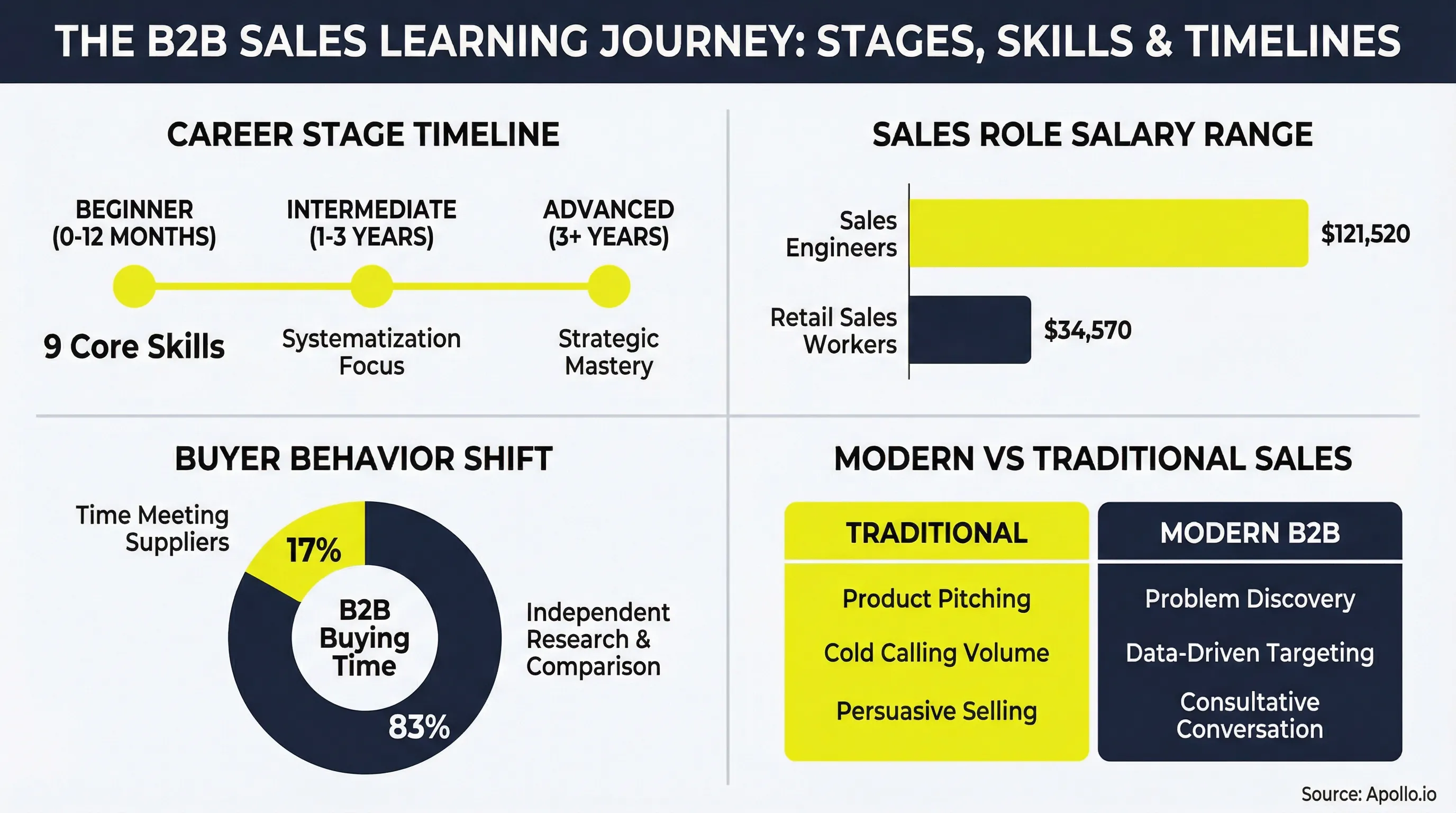
Learning to sell effectively starts with recognizing where you are in your professional journey. Each stage requires different focus areas and realistic expectations about what success looks like.
The Beginner Stage (0-12 Months)
New salespeople typically experience high anxiety and survival mode thinking. Your primary focus should be building confidence and foundational skills. According to Bureau of Labor Statistics data, median annual wages for sales occupations vary significantly by role, with sales engineers earning $121,520 while retail sales workers earn $34,570. This wide range reflects the diverse skill requirements across the profession.
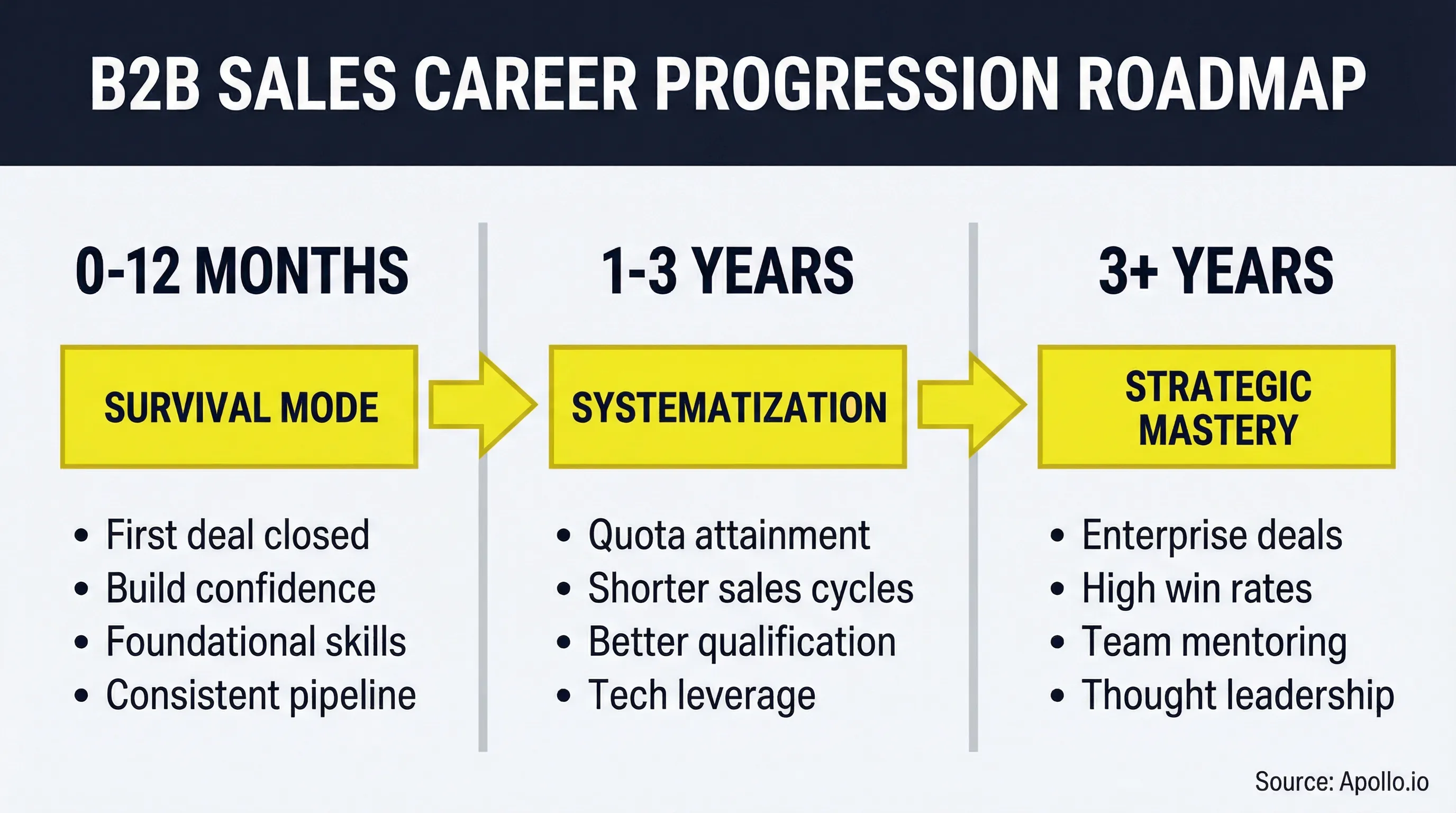
Success metrics at this stage include closing your first deal, maintaining consistent pipeline activity, and developing a repeatable approach. Don't expect perfection—focus on learning from every interaction.
The Intermediate Stage (1-3 Years)
After your first year, you'll start developing consistency and refining your approach. This stage centers on systematization and efficiency. Your goal is predictable quota attainment and shorter sales cycles through better qualification and time management.
The Advanced Stage (3+ Years)
Experienced professionals think strategically, mentor others, and navigate complex deals. Success metrics include enterprise-level transactions, high win rates, and team influence. You've moved from surviving to thriving.
Beginner Sales Skills: Your Foundation
The first year of your career requires mastering nine core competencies that form the bedrock of effective selling.
1. Adopt a Modern Sales Mindset
Old-school tactics focused on persuasion and aggressive pitching no longer work in today's B2B environment. Modern buyers are educated, skeptical, and prefer consultative conversations over hard sells. Shift your thinking from "How do I convince them?" to "How do I help them solve problems?"
Overcoming call anxiety starts with a simple truth: prospects cannot physically hurt you. They have no control over you beyond ending a conversation. This psychological realization helps override the fight-or-flight response many new reps experience.
Using data and research before outreach significantly reduces fear. When you know your prospect's company, industry challenges, and potential pain points, you approach conversations with confidence rather than desperation.
2. Master Your First 30 Seconds
Imagine you're in an elevator with an ideal prospect. They ask, "What do you do?" What comes out of your mouth in the next 25-30 seconds determines whether they want to continue the conversation.
Most beginners drone on without a clear point. Script your opening, memorize it, and practice until it feels natural. Your value statement should be concise, relevant to their world, and create curiosity rather than explain everything.
3. Learn to Ask Questions (Not Pitch)
Pitching kills deals. When you launch into product features before understanding needs, prospects tune out immediately. Instead, develop discovery question frameworks that get buyers talking about their challenges, goals, and current situation.
Active listening means staying present in the conversation rather than formulating your next response. Recent data shows that the longer prospects talk at the beginning of sales interactions, the more likely they are to buy. Make it your goal to get them talking early and often.
4. Follow a Proven System
There's no such thing as a born salesperson. After working with thousands of sales professionals, the pattern is clear: those who follow systematic approaches succeed faster than those trying to figure it out alone.
Choose a proven methodology—whether it's SPIN Selling, Challenger Sale, MEDDIC, or another framework—and implement it consistently. Don't try to create your own approach by pulling ideas from 25 different sources. Master one system first.
5. Build Basic Product Knowledge
Understanding features versus benefits is crucial. Features describe what your product does; benefits explain how it solves problems. Buyers care about the latter.
Learn your competitive advantages and use your solution yourself whenever possible. Create a personal knowledge base you can reference quickly during conversations.
6. Develop Customer-Centric Communication
Communication extends beyond speaking clearly. It includes writing effective emails, conducting professional video calls, and delivering presentations that engage rather than bore.
Remember: prospects don't care about you, your company, or your product. They care about themselves and their challenges. Frame every communication around their world, not yours.
7. Understand Basic Prospecting
Prospecting is the lifeblood of your pipeline. Start by defining your ideal customer profile—the characteristics of companies and individuals most likely to benefit from your solution.
Establish daily prospecting habits. Even 30 minutes of focused prospecting activity each day compounds into significant pipeline growth over time. Modern prospecting leverages B2B contact databases to identify and reach the right people efficiently, rather than relying solely on cold calling volume.
8. Practice Objection Handling Fundamentals
Objections are opportunities to ask more questions, not roadblocks. The five most common objections are price, timing, competition, authority, and need. Develop basic response frameworks for each.
Know when to push and when to retreat. Not every objection can be overcome, and that's okay. Role-play exercises with colleagues help you practice responses in a low-stakes environment.
9. Learn Deal Hygiene
CRM basics and data entry might seem tedious, but they're essential. Following up systematically, setting clear next steps, and managing your pipeline effectively separate professionals from amateurs.
Never end a conversation without scheduling the next step. If a prospect won't commit to a specific next action, it's a red flag that you haven't demonstrated enough value.
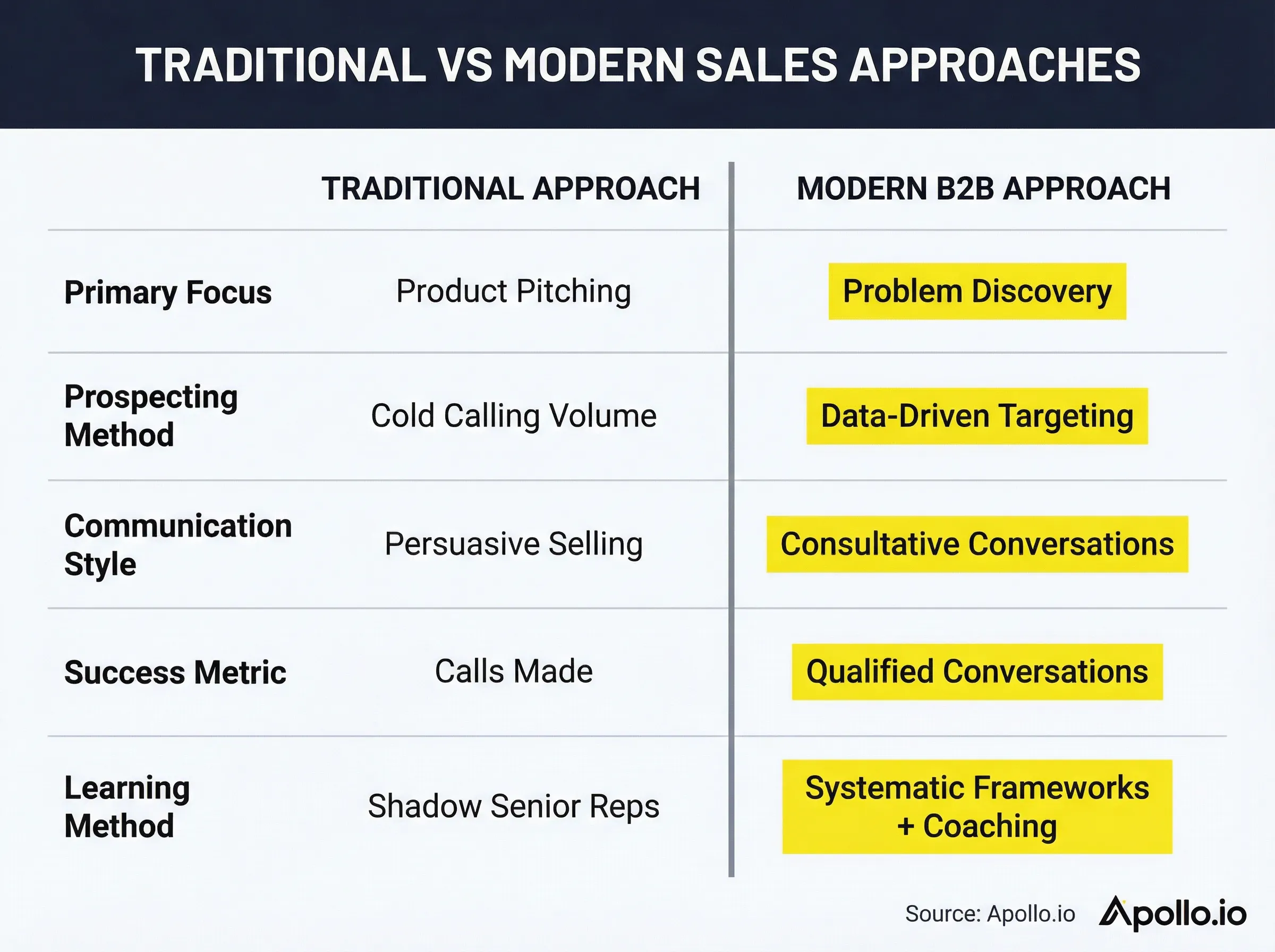
| Aspect | Traditional Approach | Modern B2B Approach |
|---|---|---|
| Primary Focus | Product pitching | Problem discovery |
| Prospecting Method | Cold calling volume | Data-driven targeting |
| Communication Style | Persuasive selling | Consultative conversation |
| Success Metric | Calls made | Qualified conversations |
| Learning Method | Shadow senior reps | Systematic frameworks + coaching |
Intermediate Sales Skills: Building Consistency
After mastering the fundamentals, intermediate sellers focus on systematization, efficiency, and leveraging technology to scale their efforts.
Advanced Prospecting with Sales Intelligence
Multi-channel prospecting strategies combine email, phone, social media, and other touchpoints to reach prospects where they're most responsive. According to recent B2B sales research, buyers now use an average of 10 different interaction channels, up from 5 in 2016.
Using intent data and buying signals helps you prioritize accounts showing active interest. Building targeted account lists based on firmographic data, technographic signals, and engagement patterns increases conversion rates significantly.
Personalization at scale seems contradictory, but modern tools make it possible. For example, when researching prospects before calls, you can use company and contact data from platforms like Apollo to understand organizational structure, recent company news, technology stack, and individual backgrounds. This information allows you to craft relevant opening messages and questions.
Practical Example: Before calling a VP of Sales at a fast-growing SaaS company, spend five minutes reviewing their LinkedIn profile, recent company funding announcements, and job postings. Notice they're hiring 10 new account executives? Your opening question might be: "I saw you're scaling your sales team significantly. What's your biggest challenge in ramping new reps quickly?" This demonstrates research and immediately addresses a likely pain point.
Mastering Discovery Conversations
Advanced questioning techniques go beyond surface-level needs. Uncover hidden pain points by asking about implications and consequences, not just current state.
BANT (Budget, Authority, Need, Timeline) and MEDDIC (Metrics, Economic Buyer, Decision Criteria, Decision Process, Identify Pain, Champion) qualification frameworks help you assess deal quality early. Learning to navigate organizational politics and conduct multi-stakeholder discovery separates intermediate sellers from beginners.
Presentation and Demo Excellence
Customize presentations by persona. What matters to a CFO differs dramatically from what matters to an operations manager. Story-based selling techniques make your presentations memorable and relatable.
Visual selling with diagrams and frameworks helps complex concepts land. Practice handling technical questions gracefully, and know when to involve subject matter experts.
Negotiation Fundamentals
Protecting deal value means understanding when to hold firm on pricing and when flexibility makes sense. Handle pricing objections by reinforcing value and ROI rather than immediately offering discounts.
Create win-win scenarios where both parties feel they've achieved their objectives. Know when to walk away from deals that don't make sense for either party.
Leveraging Sales Technology
CRM optimization ensures you're tracking the right information and using automation features effectively. Email sequencing and automation tools help maintain consistent outreach without manual effort for every touchpoint.
Sales engagement platforms coordinate multi-channel outreach and track engagement across touchpoints. For instance, Apollo combines contact data with engagement tools, allowing you to identify prospects, enrich their information, and execute outreach campaigns from a single platform. This integration eliminates the need to toggle between multiple tools and ensures your prospecting data stays current.
Conversation intelligence tools record and analyze sales calls, providing insights on talk-to-listen ratios, question patterns, and successful conversation structures. Data-driven decision making replaces gut feelings with measurable insights.
Time Management and Productivity
Prioritize high-value activities that directly impact pipeline and revenue. Daily and weekly planning systems help you allocate time intentionally rather than reactively.
Avoid common time wasters like unqualified prospects, excessive meeting preparation, and administrative tasks that could be automated. Batch similar activities—like prospecting calls or email writing—to maintain focus and efficiency.

Reach the Right People With the Right Message
Trusted by over 500,000 companies, Apollo combines contact data with multi-channel engagement tools so you can execute personalized outreach campaigns without toggling between platforms. Build targeted lists, enrich prospect data, and automate follow-up—all in one place.
Learn More →Advanced Sales Skills: Strategic Mastery
Experienced professionals operate at a strategic level, managing complex deals, building executive relationships, and mentoring others.
Complex Deal Navigation
Enterprise sales cycles involve multiple stakeholders, lengthy evaluation periods, and significant organizational change. Building champion relationships—internal advocates who sell on your behalf—becomes critical.
Creating business cases and ROI justification frameworks helps economic buyers secure internal approval. Navigate legal and procurement processes by understanding common concerns and addressing them proactively.
Strategic Account Planning
Account mapping techniques visualize organizational structure, decision-making processes, and relationship networks. Identify expansion opportunities within existing accounts through cross-sell and upsell strategies.
Executive relationship building requires different skills than individual contributor relationships. Long-term account strategy focuses on becoming an indispensable partner rather than a transactional vendor.
Thought Leadership and Personal Brand
Content creation for sales—whether LinkedIn posts, blog articles, or speaking engagements—positions you as an industry expert. Social selling mastery means using platforms like LinkedIn strategically to share insights, engage with prospects, and build credibility.
Industry expertise development takes years but pays dividends through inbound interest and higher close rates. Speaking and presenting at industry events amplifies your reach and authority.
Coaching and Mentoring Others
Transitioning to sales leadership requires developing coaching skills. Effective coaching techniques focus on asking questions rather than providing answers, helping reps discover solutions themselves.
Building sales playbooks documents your successful approaches so others can replicate them. Knowledge transfer ensures organizational learning doesn't walk out the door when top performers leave.
Modern B2B Sales: Data-Driven Prospecting Methods
The shift to intelligence-based selling represents one of the most significant changes in B2B sales over the past decade. Spray-and-pray tactics—sending generic messages to massive lists—no longer work.
According to recent industry research, 80% of B2B sales interactions now happen in digital channels, and 33% of buyers prefer a seller-free experience. This rises to 44% among millennial buyers. These statistics underscore why data-driven, highly relevant outreach matters more than ever.
Buyer behavior has fundamentally changed. Research shows buyers spend only 17% of their total buying time meeting potential suppliers. The rest is spent researching independently, comparing options, and building internal consensus. Your job is to make those brief interactions count by demonstrating deep understanding and providing genuine value.
Building Your Prospecting Tech Stack
Essential tools for modern prospecting include sales intelligence platforms, engagement tools, CRM systems, and conversation intelligence software. Integration strategies ensure these tools work together seamlessly rather than creating data silos.
ROI considerations matter. According to sales training research, 62% of sales leaders indicate outdated training is the biggest barrier to delivering effective programs. Investing in the right technology and training pays dividends through improved efficiency and higher conversion rates.
| Platform Type | Best For | Key Strength | Typical Use Case |
|---|---|---|---|
| All-in-one prospecting + engagement | Teams wanting integrated workflows | Combines contact data with outreach tools | End-to-end prospecting from research to engagement |
| Standalone contact databases | Research-focused teams | Deep data coverage | Building targeted prospect lists |
| Sales engagement platforms | High-volume outreach | Multi-channel sequencing | Automating follow-up cadences |
| Conversation intelligence | Coaching and improvement | Call analysis and insights | Identifying successful conversation patterns |
Personalization at Scale
Using data for relevant outreach means going beyond first name tokens in email templates. Reference specific company initiatives, recent news, technology stack, or organizational changes that create genuine buying triggers.
Dynamic email personalization adapts messaging based on industry, role, company size, and other attributes. Account-based approaches coordinate personalized outreach across multiple stakeholders within target accounts.
Measuring personalization effectiveness helps you understand which approaches resonate. Track response rates, meeting booking rates, and pipeline generation by message type and personalization level.
Measuring What Matters
Key performance indicators vary by stage. Beginners should focus on activity metrics (calls made, emails sent, meetings booked) while building skills. Intermediate sellers track conversion rates at each pipeline stage. Advanced professionals measure deal size, sales cycle length, and win rates.
According to industry conversion rate data, the average e-commerce conversion rate across sectors stands at 1.6%, with significant variation by industry. While B2B sales differs from e-commerce, understanding conversion benchmarks helps you set realistic expectations and identify improvement opportunities.
Leading indicators (activities you control) predict lagging indicators (results you achieve). Focus on improving leading indicators—like discovery call quality or proposal customization—and results will follow.
Creating Your Personal Learning Plan
Systematic skill development requires honest self-assessment and structured learning.
Self-Assessment: Where Are You Now?
Create a skills inventory checklist covering the competencies discussed in this guide. Rate yourself honestly on each skill from 1-5. Identify your biggest gaps—these become your development priorities.
Set SMART goals (Specific, Measurable, Achievable, Relevant, Time-bound) for each skill you want to improve. For example: "Increase discovery call duration from 15 minutes to 25 minutes by asking at least 8 open-ended questions per call, measured over the next 30 days."
Timeline expectations vary by stage. Beginners typically need 6-12 months to feel confident in foundational skills. Intermediate sellers spend 1-3 years developing consistency. Advanced mastery takes 3+ years of deliberate practice.
Learning Resources and Training Options
Online courses and certifications provide structured learning paths. Books and podcasts offer continuous education during commutes or downtime. Sales communities and forums connect you with peers facing similar challenges.
Formal training programs accelerate learning but require time and financial investment. According to recent training statistics, 90% of sales leaders prefer a mix of in-person and virtual training, and 55% feel their current programs are effective but offer limited results. This suggests that supplementing formal training with self-directed learning produces the best outcomes.
| Resource Type | Best For | Time Investment | Cost | Hands-On Practice |
|---|---|---|---|---|
| Online courses | Structured learning | 10-40 hours | $0-$500 | Limited |
| Sales bootcamps | Career changers | 8-12 weeks | $3,000-$15,000 | High |
| Books/podcasts | Continuous learning | Flexible | $0-$100 | Self-directed |
| On-the-job training | Active sellers | Daily | Free | Maximum |
| Sales intelligence tools | Practical application | Ongoing | $49+/month | Real-world practice |
Practice Strategies That Work
Role-playing frameworks help you practice conversations in low-stakes environments. Record and review your calls to identify patterns and improvement opportunities. Shadow top performers to observe their techniques in action.
Get feedback effectively by asking specific questions: "How could I have handled that objection better?" rather than "How did I do?" The 10,000-hour principle applies to sales—mastery requires extensive deliberate practice over time.
Building Your Sales Journal
Document wins and losses immediately after they occur. Extract lessons from failures by asking: What went wrong? What could I have done differently? What will I do next time?
Track skill development over time. Review your journal monthly to identify patterns. This practice accelerates learning by forcing reflection and conscious improvement.
Common Mistakes When Learning Sales (And How to Avoid Them)
Trying to figure it out alone wastes time. Seek mentorship, follow proven systems, and learn from those who've succeeded before you.
Focusing on tactics over strategy creates short-term wins but long-term stagnation. Understand the "why" behind techniques, not just the "how."
Neglecting fundamentals in favor of advanced techniques is like trying to run before you can walk. Master the basics first.
Not using available technology puts you at a competitive disadvantage. Modern buyers expect personalized, informed interactions that require data and tools.
Avoiding uncomfortable activities—like cold calling or asking for referrals—limits your growth. Discomfort signals learning opportunities.
Giving up too early is perhaps the most common mistake. Sales skills take time to develop. Most successful salespeople struggled initially but persisted through the survival phase.
Your Path Forward
Learning to sell is a journey, not a destination. Start by honestly assessing which stage you're in and which skills need the most development. Choose 2-3 specific competencies to focus on first rather than trying to improve everything simultaneously.
Modern B2B selling requires modern methods. Data-driven prospecting, consultative conversations, and strategic use of technology aren't optional—they're essential. The good news is that these skills can be learned systematically with the right approach and consistent effort.
Remember: there's no such thing as a born salesperson. Every top performer you admire started exactly where you are now—uncertain, anxious, and learning. The difference is they committed to continuous improvement and refused to give up during the difficult early stages.
Take action today. Identify one skill from this guide, set a specific goal, and practice deliberately for the next 30 days. Track your progress, seek feedback, and adjust your approach based on results. That's how you transform from a struggling beginner into a confident, successful sales professional.
Ready to accelerate your prospecting skills with modern tools? Explore how Apollo can help you identify ideal prospects, enrich contact data, and execute personalized outreach campaigns—all from a single platform designed for today's B2B sellers.
Master Modern B2B Selling With Apollo
Stop juggling multiple tools and manual processes. Join 550K+ companies scaling smarter with Apollo's all-in-one sales intelligence and engagement platform. Get verified contact data, AI-powered lead scoring, and automated outreach in a single workflow. Free plan available - no credit card required.
Get Started Free →